Telegram has quietly become one of the most important sales channels for businesses selling through direct messaging, from crypto projects to e-commerce brands to local service providers. As the channel matures, so does the tooling behind it — and the debate over ai agent vs ai bot telegram has moved from a technical curiosity to a real business decision. Choosing wrong means either overpaying for capability you don't need, or watching leads slip away because your "smart" bot can't actually think.
Why Telegram Businesses Are Rethinking Bots and Agents
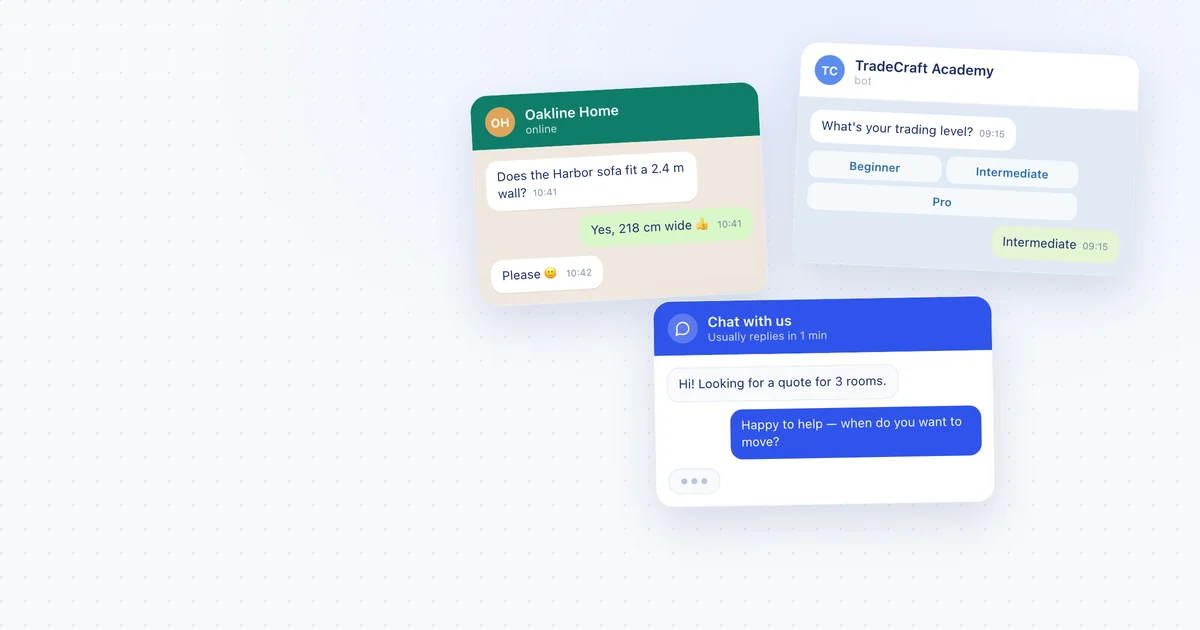
For years, a Telegram bot meant a set of buttons, a decision tree, and a handful of canned replies. That worked fine when Telegram was mostly used for community updates and simple FAQs. But now buyers expect to negotiate, ask follow-up questions, compare options, and get answers that reference their own order history — all inside the same chat thread they use to message friends.
This shift is why so many teams are searching for the actual difference between ai agent and chatbot before they invest more budget. A scripted bot can survive a "What are your hours?" question. It usually collapses the moment someone asks, "Can I get the blue one in a smaller size, and does it ship faster than the one I asked about yesterday?" That kind of question needs memory, reasoning, and access to real data — not a flowchart.
The stakes are higher because Telegram conversations often are the sales funnel. There's no separate landing page journey to fall back on; the chat is the storefront, the support desk, and the checkout counter all at once. If the automation layer can't keep up, the business loses the sale right there in the thread.
What Is a Telegram AI Bot, Really
A classic Telegram bot — even one marketed as "AI-powered" — is typically rules-based automation with some natural language processing sprinkled on top for intent detection. It listens for keywords or trigger phrases, matches them to predefined responses, and moves users through a fixed sequence of steps: welcome message, menu, form, confirmation.
Some of these bots use basic machine learning to classify messages ("this looks like a pricing question") and route them to the right canned reply. That's useful, and it's genuinely better than nothing. But the intelligence stops at classification. The bot doesn't understand context across a conversation, it can't reason about edge cases, and it has no real memory of what the user said three messages ago unless a developer explicitly coded that state into the flow.
In practice, a Telegram AI bot works well for:
- Answering a fixed list of FAQs
- Collecting structured information via forms or button menus
- Sending order confirmations or shipping updates
- Routing users to the right department or human agent
It's fast to build, cheap to run, and predictable. The tradeoff is rigidity: the moment a conversation goes off-script, the bot either loops, misfires, or hands the user to a human — which somewhat defeats the purpose of automating in the first place.
What Makes an AI Agent Different (Beyond Scripted Replies)
A telegram ai agent is built on a large language model rather than a decision tree. Instead of matching keywords to fixed responses, it interprets meaning, holds context across the entire conversation, and generates a reply tailored to that specific exchange. Ask it the same question two different ways and it understands both. Ask a follow-up that depends on something you said five minutes earlier, and it remembers. That's the core distinction people are getting at when they search for the difference between ai agent and chatbot: a chatbot follows a script, an agent pursues a goal. The goal might be "qualify this lead," "recover this cart," or "close this sale," and the agent adapts its language, tone, and next question to move toward that goal rather than reciting a fixed line.
Beyond conversation quality, agents can take actions. A well-built ai sales agent telegram deployment can look up a customer's order status, check inventory, apply a discount code, update a CRM record, or escalate to a human — all triggered by understanding what the customer actually needs, not by the customer clicking the "right" button in a menu. This is where an ai agent telegram crm integration earns its keep: the agent isn't just chatting, it's reading and writing real business data as the conversation happens.
None of this means agents are flawless. They can be less predictable than rigid bots, and they need guardrails — clear instructions, access boundaries, and fallback logic — to avoid hallucinating information or promising something the business can't deliver. But when configured properly, they close the gap between "answering questions" and "advancing a sale."
AI Agent vs AI Bot: A Side-by-Side Comparison
Putting them next to each other makes the practical tradeoffs easier to see in this telegram bot vs ai agent comparison.
| Capability | Traditional Telegram Bot | AI Agent |
|---|---|---|
| Conversation style | Fixed menus, scripted replies | Natural, context-aware dialogue |
| Handling unexpected questions | Fails or loops back to menu | Interprets intent and responds directly |
| Memory across the conversation | Limited to coded state | Tracks context throughout the chat |
| Access to CRM/order data | Only if explicitly wired in per flow | Can query and update data as needed |
| Negotiation or objection handling | Not possible without human handoff | Can respond to objections in real time |
| Setup effort | Lower, but scales poorly with complexity | Higher upfront, scales better long-term |
| Best use case | FAQs, simple routing, notifications | Lead qualification, sales conversations, support with data lookups |
Neither option is universally "better." A bot that answers shipping FAQs doesn't need reasoning ability. But a business trying to close deals through chat, where every lead asks slightly different questions, will hit the ceiling of a bot fairly quickly.
How an AI Sales Agent Handles Real Conversations and CRM Data
The real value of an ai sales agent telegram setup shows up when it's connected to the systems that actually run the business — not just chatting in isolation. Imagine a lead messages asking about a product, mentions a budget, and asks if there's a discount for returning customers. A scripted bot would need three separate menu paths pre-built for that exact combination. An agent connected to CRM data can pull up the lead's history, see they're a returning customer, check the current promotion, and answer in one natural reply — then log the interaction and move the deal to the next pipeline stage automatically.
This is the practical meaning of ai agent telegram crm integration: the conversation and the sales pipeline stop being separate systems. In a setup like Torro, for example, every Telegram (and WhatsApp) conversation lands in a shared team inbox, the AI sales agent can respond using real CRM context, and qualified leads get pushed into a kanban pipeline without anyone manually copying details between apps. If a conversation needs a human touch — a big-ticket negotiation, a complaint, a VIP client — the automation builder can hand it off to a rep with the full conversation history attached, so nothing gets repeated or lost.
That handoff matters as much as the automation itself. The goal isn't to replace every human interaction; it's to make sure the AI agent handles the repetitive 80% (qualifying, answering, following up) so the sales team spends their time on the 20% that actually needs a person — the negotiations, the edge cases, the relationship-building.
Analytics close the loop. Once conversations, pipeline stages, and outcomes are tracked in one place, it becomes possible to see which messages actually convert, where leads drop off, and whether the AI agent is closing deals or just fielding questions.
When a Simple Bot Is Enough vs When You Need an Agent
Not every Telegram presence needs a full AI agent, and it's worth being honest about that before spending on infrastructure you don't need.
A simple bot is enough when:
- Your questions are genuinely repetitive and limited in number (hours, location, shipping policy)
- You're mostly broadcasting updates rather than holding two-way conversations
- Your sales process happens elsewhere (a website, a call) and Telegram is just for support
- Volume is low enough that a human can pick up the slack quickly
You need an agent when:
- Leads ask varied, unpredictable questions that don't fit a menu
- Closing a sale requires referencing account-specific data (order history, pricing tiers, past conversations)
- You're running paid ads or campaigns that funnel volume into Telegram and can't staff every conversation manually
- You want the same customer experience whether someone messages at 2pm or 2am
- You're already juggling multiple channels (Telegram and WhatsApp, for instance) and need consistent handling across both
Many businesses land somewhere in between: a bot handles the first response and basic routing, and an agent takes over once the conversation gets specific. That layered approach often makes financial sense — you're not paying for full reasoning power on messages that a simple rule could have handled.
Choosing the Right Solution for Your Telegram Sales Funnel
The ai agent vs ai bot telegram decision ultimately comes down to how unpredictable your conversations are and how much that unpredictability costs you in lost sales. If your funnel is narrow and repetitive, a bot is cheaper, faster to deploy, and perfectly adequate. If your funnel involves negotiation, personalization, or data lookups that change the answer every time, an agent isn't a luxury — it's the difference between a lead that converts and one that bounces to a competitor who answered faster and smarter.
Whichever direction fits your business, the infrastructure around the AI matters as much as the AI itself. A brilliant model with no connection to your CRM, pipeline, or team inbox is just an isolated chat window — impressive in a demo, less useful in daily operations. Platforms like Torro are built around that gap: combining the AI sales agent with the shared inbox, pipeline, and automation builder so that every Telegram (and WhatsApp) conversation feeds directly into the sales process instead of sitting disconnected from it.
Start by mapping the actual questions your Telegram audience asks in a typical week. If that list is short and stable, a bot will serve you well for a long time. If it keeps growing and branching in ways no flowchart could anticipate, that's your signal to move toward an agent — one connected to real data, not just replies.