
Telegram stopped being "the app for crypto and privacy nerds" a while ago. With well over a billion monthly users and message open rates that make email look like a fax machine, it has quietly become one of the highest-intent sales channels most teams still treat as a broadcast toy. If your idea of selling on Telegram is posting a promo in a channel and hoping someone slides into your DMs, you're leaving most of the money on the table. This guide breaks down how selling on Telegram actually works in 2026 — the surfaces you have, the tooling behind them, and the funnel that turns a cold click into a paid order.
Why Telegram converts differently than every other channel
The core reason to sell on Telegram is attention. A message that lands in someone's Telegram gets seen — often within minutes — because there's no algorithmic feed burying it and no "Promotions" tab quarantining it. Broadcast open rates on messenger channels routinely sit in the 60–90% range, versus the 20-something percent email considers a good day. That's not a small edge; it changes what's possible in a funnel.
But high open rates cut both ways. Because the channel feels personal, buyers expect a personal, fast, human-quality response. A generic "Hi, still interested?" three hours later kills the exact intent that made Telegram valuable in the first place. Selling here well means matching the intimacy and speed of the medium, not spamming it like a mailing list.
Channels vs. groups vs. DMs: pick the right surface for the job
Telegram gives you three fundamentally different selling surfaces, and the most common mistake is trying to make one do the job of all three.
Channels — your one-to-many storefront
A channel is a broadcast: you post, everyone subscribed sees it, and only admins can publish. Channels are for demand generation and nurturing — launches, offers, social proof, educational content that keeps you top-of-mind. What a channel is not good at is closing. There's no real conversation, so a channel's only job is to move a warm reader one tap closer to a real dialogue.
Groups — community and social proof
Groups are many-to-many. They're excellent for community, support, and letting prospects see other happy customers in the wild, which does more selling than any post you could write. The tradeoff is moderation load and noise. Use groups to build trust and reduce buyer risk, not to run one-on-one sales conversations that belong in private.
DMs — where deals actually close
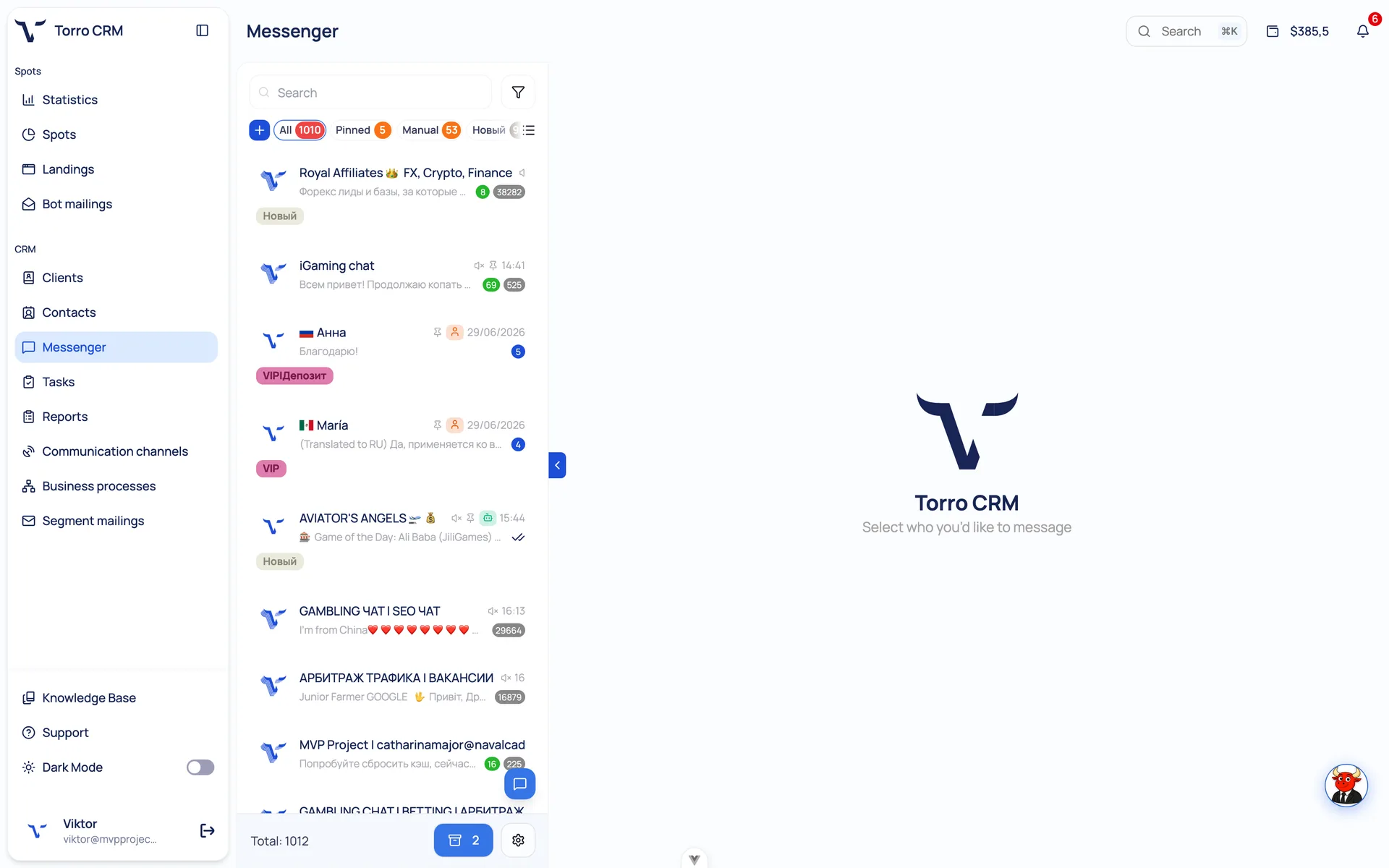
Direct messages are where money changes hands. This is the qualifying conversation: understanding the need, handling objections, sending the offer, and getting to payment. Everything upstream — the channel post, the group discussion, the ad — exists to route a person into a DM at the moment their intent is highest. If you only fix one thing about your Telegram selling, make it the DM experience.
Channels create demand, groups create trust, DMs create revenue. Treat them as one relay, not three separate tactics.
From BotFather to an AI agent: the bot spectrum
"Bot" on Telegram covers a huge range, from a five-minute toy to a system that runs your sales floor. Knowing where on that spectrum you need to be saves you from both over- and under-engineering.
The BotFather starting line
Every Telegram bot begins the same way: you message @BotFather, run /newbot, name it, and get an API token. That token is the key to the Bot API. On its own, a fresh bot does nothing — it's a blank endpoint waiting for logic. For simple use cases (a link menu, an FAQ, a "get the file" flow) a basic bot built on that token is genuinely enough, and you can ship it in an afternoon.
Rule-based bots and their ceiling
The next step up is a scripted bot: buttons, menus, decision trees, maybe a keyword responder. These handle predictable paths well — pricing, hours, "how do I start" — and they scale infinitely for FAQ-type traffic. Their ceiling is the moment a prospect goes off-script. Real buyers ask messy, specific questions ("does this work for a 3-person team in Brazil that already uses X?"), and a decision tree either dead-ends or dumps them to a human who may be asleep.
The AI agent tier
This is where 2026 selling lives. An AI sales agent reads free-form messages, understands intent, answers in natural language, and — critically — acts: it qualifies the lead, asks the right follow-up, fills in the CRM card, tags the deal, and moves it down the pipeline without a human touching it. The difference from a rule-based bot is the difference between a phone menu and a competent salesperson. Platforms like Torro AI sit at this tier: an agent that replies in Telegram (and WhatsApp), works from a knowledge base so it doesn't hallucinate your pricing, handles voice notes both ways, and pushes qualified leads into a kanban CRM automatically. The point isn't to remove humans — it's to stop paying them to type "Hi, is this still relevant?" a hundred times a day.
| Capability | Basic bot | Rule-based bot | AI agent |
|---|---|---|---|
| Setup time | Minutes | Hours–days | Minutes (no code) |
| Handles off-script questions | No | No | Yes |
| Qualifies leads | No | Partially | Yes |
| Updates CRM automatically | No | Rarely | Yes |
| 24/7 human-quality replies | No | Scripted only | Yes |
The click-to-pay funnel, step by step
Selling on Telegram works when every surface feeds a single continuous path from first click to payment. Here's the funnel that actually converts, in order.
- Traffic source with a tracking link. An ad, a channel post, a bio link — each carries a unique tracking URL so you know where the lead came from. Without this, you're optimizing blind.
- Deep link into a DM or bot. Telegram's
t.me/yourbot?start=source_codedeep links drop a person straight into a conversation with the source already attached. This is the single most underused trick in Telegram selling — the funnel starts inside the chat, not on a landing page. - Instant qualifying reply. The moment they land, they get a real response — a greeting plus a smart question. Speed here is everything (more on that below).
- Conversation and objection handling. Understand the need, surface the right offer, answer the follow-ups. This is where an AI agent earns its keep versus a menu.
- The offer and the payment link. A clear next step: a Telegram payment, an invoice, or a checkout link — delivered in-chat while intent is hot.
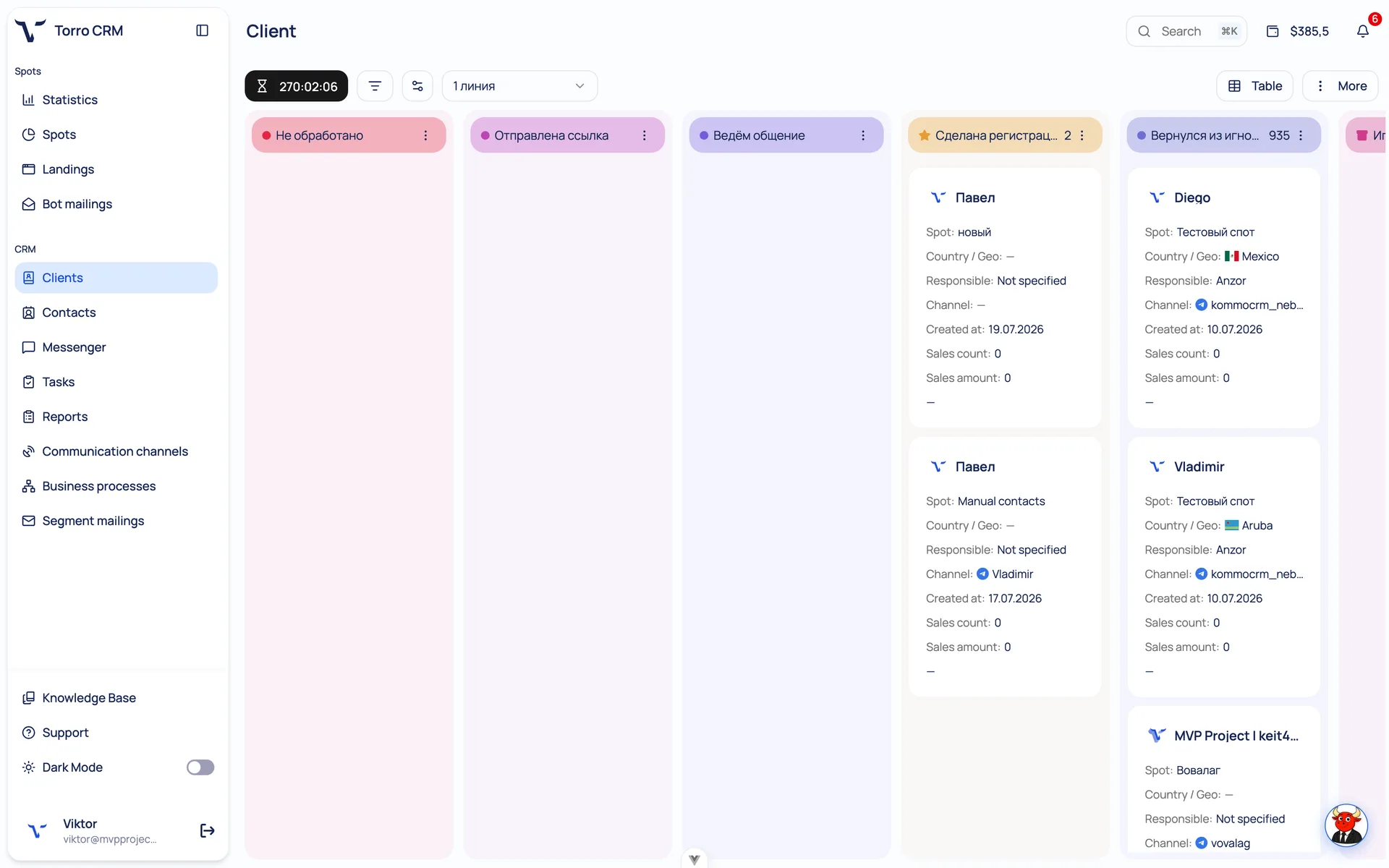
- CRM handoff and follow-up. Deal moves to the right kanban stage; if payment doesn't happen, a scheduled follow-up brings them back instead of letting the lead rot.
Notice that steps 3 through 6 are pure conversation work — exactly the part that's expensive to staff and easy to drop after hours. Automating that middle is where the biggest conversion gains hide.
Speed-to-lead: the metric that quietly decides everything
If there's one number to obsess over, it's how fast you respond to a new inbound. The research on this is brutal and consistent across channels: responding within the first five minutes versus even thirty minutes can multiply your odds of qualifying the lead many times over. Wait an hour and, for a lot of buyers, the intent is simply gone — they've moved on, gotten distracted, or messaged a competitor.
On Telegram this effect is amplified because the medium feels instant. A buyer who messages your channel at 11 p.m. expects a reply that fits the app's rhythm, not your office hours. Humans can't cover that — nobody responds to every DM in under a minute, all night, in every language your ads run in. This is the cleanest, most honest case for an AI agent: not to sound clever, but to guarantee that a real, useful reply hits within seconds of the first message, every time. When speed-to-lead goes from "sometimes hours" to "always seconds," the conversion lift shows up in the funnel numbers, not in a slide.
Tracking links: sell like a performance marketer, not a poster
You can't scale what you can't measure, and most Telegram selling dies here. The fix is tracking every entry point.
- Per-source deep links. Give each ad, channel, and partner its own
?start=parameter so every conversation carries its origin from the first message. - Click-to-pay attribution. Tie the tracking link all the way through to the payment event. The goal is to say "this Instagram ad produced 40 chats and 6 paid orders," not "we got some DMs this week."
- Postback to your ad platform. Send conversion events back to the ad network so its optimizer learns which clicks turn into buyers — turning a leaky funnel into a compounding one.
This is exactly the analytics spine a tool like Torro AI is built around: tracking links from the click, attribution through the conversation, and postback at the sale, so the entire journey from ad to payment is one measurable line rather than a black box between "posted" and "hoped."
A practical starter plan for 2026
If you're setting this up from scratch, do it in this order and don't skip ahead:
- Create your bot with @BotFather and set up per-source deep links.
- Decide your surfaces: a channel for demand, a group if community fits your product, and DMs as the closing floor.
- Write down the five questions that actually qualify a buyer — this is what your agent (or human) will ask.
- Put an AI agent on the DM layer so every inbound gets a fast, on-brand, knowledge-grounded reply 24/7, and let it fill the CRM.
- Wire tracking links and postback so you can see cost-per-paid-order by source.
- Add scheduled follow-ups for the deals that stall before payment.
The bottom line
Selling on Telegram in 2026 isn't about picking the one right surface or the one clever bot trick. It's about wiring channels, groups, DMs, bots and tracking into a single click-to-pay funnel — and then defending the two moments that actually decide outcomes: the speed of the first reply and the quality of the qualifying conversation. Those are precisely the moments humans can't reliably cover around the clock and across languages, which is why the teams pulling ahead have moved the DM layer from manual typing to AI agents that answer in seconds and update the pipeline on their own. Get the funnel continuous and the response instant, and Telegram stops being a place you post — and becomes the channel where you close.