Just three years ago, "selling through messaging apps" in the CIS market meant WhatsApp, by default. In 2026, the picture looks different. WhatsApp is unreliable in the region, a chunk of the audience has moved on, and the habit of chatting, consuming content, and buying has shifted to Telegram. Today it's channel number one: your customers are there, so are your competitors, and it's where the lead's money actually gets decided — won by whoever replies within a minute, not whoever "saw the message in the evening."
The problem is that most companies use Telegram on instinct: they spin up a channel, drop the link into an ad, put a manager on DM duty — and then wonder why leads show up but revenue doesn't. This guide is about building an actual system: from channel structure to end-to-end analytics, and the moment manual replies should give way to an AI agent.
Telegram in 2026: why it became the primary sales channel
Messaging apps left email and phone calls behind on engagement long ago. Telegram open rates sit around 80–90%, compared to 15–25% for email campaigns, and most people see a first message within minutes of it landing. For sales, that means one simple thing: your pitch will almost certainly get read — the only question is what you write and how fast.
Telegram also wins on having a whole ecosystem inside a single app. All of these coexist:
- Channels — broadcasting to an audience, content, and warm-up.
- Direct messages — one-on-one selling, where deals actually close.
- Bots — automation: lead capture, payments, quizzes, funnels.
- Ads and seeding — traffic sources that can drop a person straight into a conversation.
The mistake is treating all of this as one channel. In practice, each piece does a different job, and sales fall apart wherever you blur their roles.
Channels, DMs, or bots: where the sale actually happens
Let's break it down by function, so you're not building a funnel by feel.
| Tool | Job | Where people get it wrong |
|---|---|---|
| Channel | Warm-up, trust, reach, repeat touchpoints | Trying to sell outright through posts and waiting for leads to show up in the comments |
| DMs | Qualification, objection handling, closing the deal | Slow replies with no script — the lead goes cold |
| Bot | Instant first response, lead capture, payment, auto-funnel | Building a menu maze with nowhere to ask a real question |
The setup that actually works in 2026 looks like this: ads or content drive a person into a conversation (bot or DM), where first contact happens, while the channel runs in the background — warming up the people who aren't ready to buy yet. The money almost always closes in one-on-one chat, so the quality and speed of that conversation is what determines your revenue.
The channel earns attention, the bot catches the lead, and the one-on-one conversation closes the deal. If you only optimize the first step and forget the third, you're paying for traffic without getting sales.
The Telegram funnel: from ad click to payment
To make sales manageable, you need to break the conversation into stages. A classic messaging-app funnel looks like this:
- Click — someone clicks an ad, a link in a post, or a seeded mention.
- First contact — they land in a bot or DM and get a greeting.
- Qualification — you find out their need, budget, and urgency.
- Offer — you present a relevant solution, not just a price list.
- Objection handling — you address doubts about price, timing, trust.
- Payment — you get them to an invoice, a link, or an order.
The key idea: at every step, some people drop off, and your job is to see exactly where. If 100 people click, 60 message you, 20 reach the offer stage, and only 3 pay — the bottleneck isn't your ads, it's qualification or objection handling. Without a stage-by-stage breakdown, you'll just "pour in more traffic" instead of fixing the leaky step.
Track conversion between stages, not just lead count
You can have plenty of leads and still little revenue, or vice versa. Watch the conversion rate between adjacent steps: click → conversation, conversation → qualified lead, lead → payment. Those percentages tell you exactly what to fix first.
Response speed: the biggest conversion multiplier
If you strip this guide down to one point, keep this one. First-response speed is the most underrated lever in messaging-app sales.
The logic is simple: the moment someone messages you, they're at peak "hot" — they just saw your ad, they're interested, the conversation is open. Ten minutes later they're in another tab; an hour later they're comparing you to three competitors; by evening they've forgotten why they wrote in the first place. Lead-generation research has shown for years that replying within 5 minutes multiplies your odds of getting the lead into an actual conversation, compared to replying an hour later.
On Telegram this bites even harder, because people expect a fast, live-chat pace. And here's where most sales teams fall apart:
- leads come in during evenings and weekends, when no one's working;
- lead flow is uneven — dead quiet, then dozens of conversations at once;
- the first message is nearly always the same generic template, with no qualification built in.
A partial fix is an instant auto-reply that goes out immediately and holds the person's attention until a manager picks up. But the real fix is an automated first response that doesn't just say hello — it starts qualifying right away. That's exactly the gap where an AI agent starts to make sense, which we'll get to below.
Auto-funnels and no-code automation
Manual work doesn't scale. Once you're past a handful of leads a day, you need automation — and in 2026 you build it out of blocks, no developer required.
The basic building blocks of a messaging-app auto-funnel:
- Triggers — an event kicks off a scenario: a new message, a click on a specific link, a tag being applied.
- Conditions and branches — the conversation follows different paths depending on the customer's answers.
- A/B branches — test two versions of a greeting or offer and keep the one that converts better.
- Delays and follow-ups — if someone doesn't reply, a reminder goes out after N hours.
- Webhooks — conversation data flows straight into your CRM, payment system, or spreadsheet.
A good rule of thumb: automate the routine parts (first response, qualification, reminders, data capture), and leave people to handle edge cases and closing the big deals. In Torro AI, these auto-funnels are built in a visual builder out of trigger blocks, conditions, and webhooks — meaning a marketer can set up the whole scenario without engineering help.
Don't skip the follow-up
Up to 50% of messaging-app sales come from later touchpoints, not the first conversation. People say "let me think about it" — and vanish, unless you remind them. An automatic follow-up a few hours later, or the next day, brings back a chunk of those leads at essentially no cost.
Tracking links: figuring out where the money actually comes from
Selling on Telegram blind means paying for ads without knowing which source drives payments and which just produces empty chats. The fix is tracking links with source tags.
Here's how it works: you create a separate tagged link for every ad creative, seeding channel, or influencer. Someone clicks it, lands in a conversation, and the system remembers where they came from. From there you see more than just "100 clicks" — you see the whole chain: source → conversation → qualified lead → payment.
What that gets you in practice:
- you can cut channels that generate clicks but no revenue;
- you can shift budget toward sources that actually produce paying customers;
- you can calculate customer acquisition cost per channel, instead of one blended "average."
The final level of maturity is end-to-end analytics with postback: payment data flows back into the ad platform, and its algorithms optimize delivery toward people who actually buy, not just people who message.
When to bring in an AI agent
Auto-replies and scripted bots handle templated tasks well, but they break down in a live conversation: the customer asks something off-menu, wants details, tries to negotiate. That's where an AI agent earns its place.
An AI agent isn't a bot with buttons — it's a conversational partner that chats in text (and voice, when needed), draws on your knowledge base, keeps the conversation's goal in view, and handles related actions on its own. It's worth bringing in once you recognize your own situation on this list:
- leads come in around the clock, and staffing a night shift isn't worth it;
- flow is uneven, and at peak times conversations wait 20–40 minutes for a reply;
- your managers burn time on repetitive qualification instead of closing deals;
- CRM records get filled in inconsistently, or not at all;
- you want one consistent standard of conversation, not "however the manager feels today."
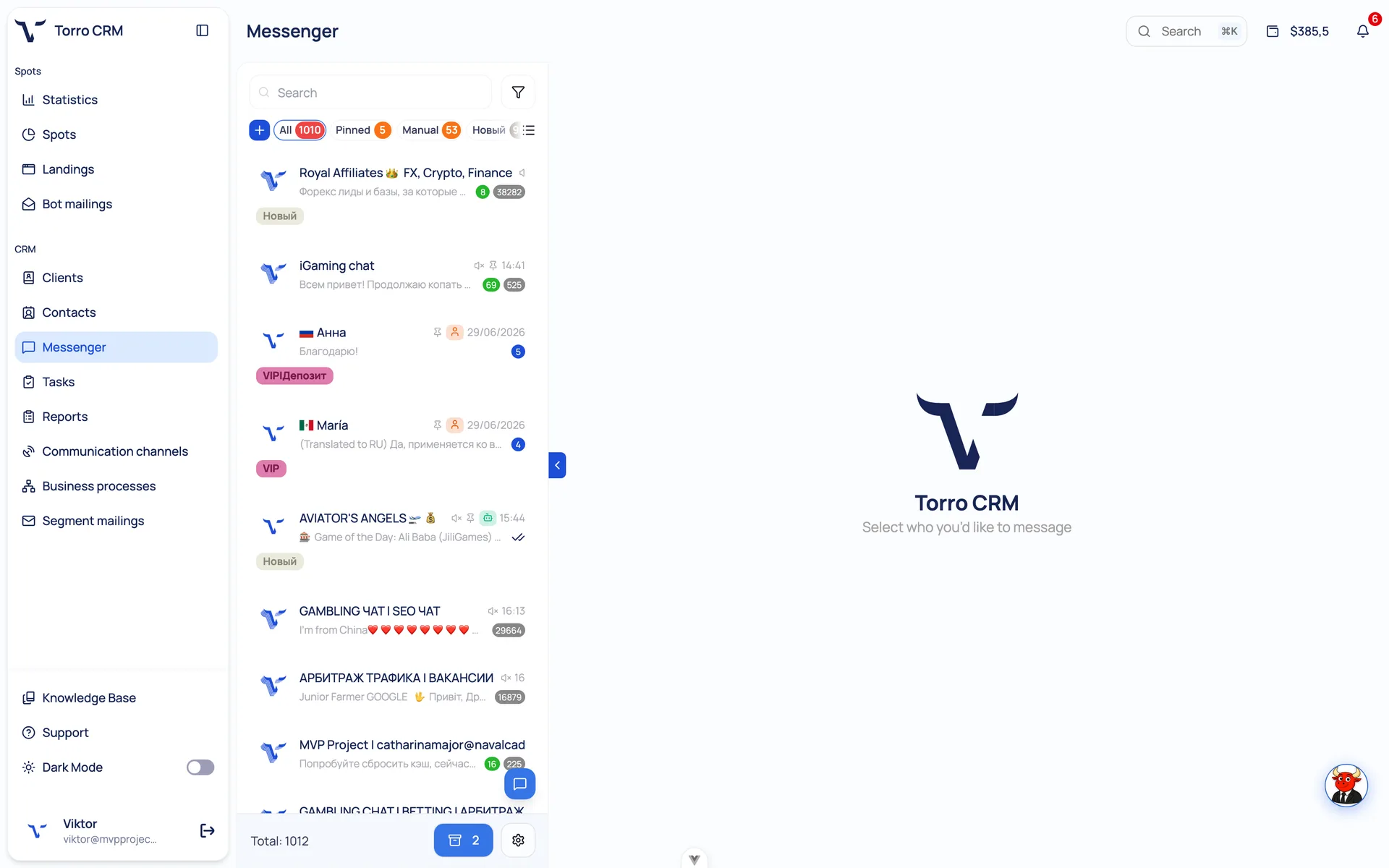
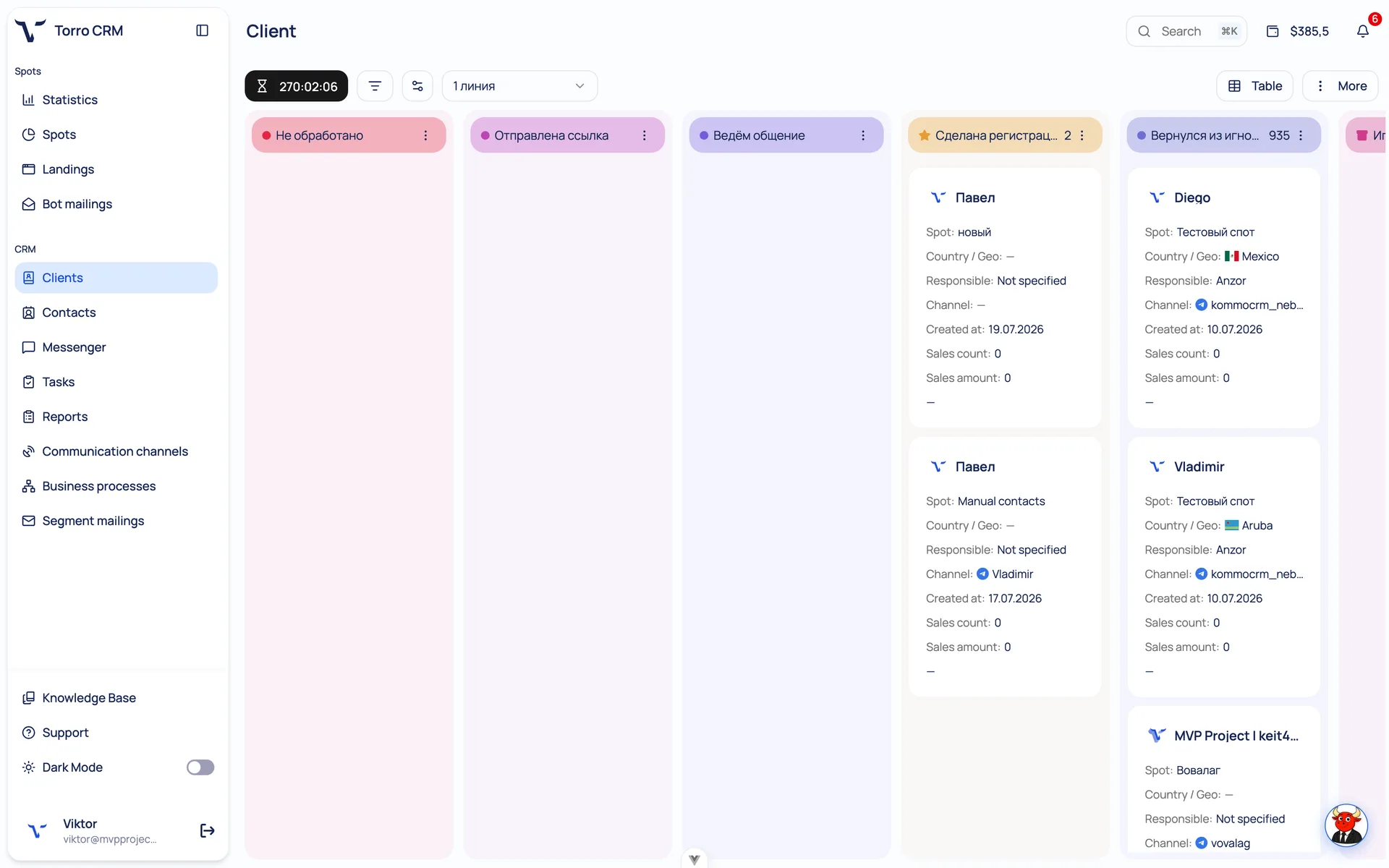
A modern AI agent, like the one in Torro AI, replies in seconds, qualifies leads against your defined goals, fills in the kanban CRM card itself, moves the deal through the pipeline, and drives it to payment — handing off tricky cases to a live manager. In effect, it closes the exact gap between "someone messaged" and "someone got a meaningful answer," which is where most revenue quietly leaks away.
How to roll it out in stages
- Start with instant first response and qualification. This delivers the biggest gain for the least risk.
- Next, auto-filling the CRM and moving cards through the kanban, so managers stop maintaining spreadsheets by hand.
- Then, follow-ups and database work: bringing back the "still thinking" crowd, reactivating old leads.
- Only after that, trust the agent with increasingly complex conversations, checking quality against the logs as you go.
It's important to give your operator a takeover button: for disputed or high-value deals, a human needs to be able to step into the conversation at any moment. A good AI agent accounts for this and hands off the conversation without losing context.
Bottom line
Selling on Telegram in 2026 isn't "start a channel and wait for leads" — it's a system built from four layers: clearly separated roles for channels, DMs, and bots; a funnel mapped out stage by stage from click to payment; ruthless first-response speed; and end-to-end analytics through tracking links. Automation and an AI agent aren't the point in themselves — they're how you plug the biggest leak: a slow, inconsistent response to an incoming lead.
Start small: map out your funnel, measure how many minutes it actually takes you to respond to a new lead, and put tracking links on your traffic sources. Those three steps alone will show you where you're losing money — and from there, deciding what to automate and when to bring in an AI agent becomes obvious, because it's based on numbers instead of gut feel.