Most businesses treat customer support and sales as two separate universes — different teams, different tools, different KPIs. But that wall is costing you money. AI customer service that increases sales isn't a gimmick or a rebrand of chatbots — it's a fundamental shift in how conversations on Telegram and WhatsApp get treated. Every "where's my order" or "does this work with X" message is a buying signal in disguise, and if your bot only knows how to close tickets, you're leaving revenue sitting in your inbox.
Why Traditional Support Bots Leave Revenue on the Table
Classic support bots are built around one goal: deflect the ticket. They match keywords, serve a canned answer or a help-center link, and close the conversation as fast as possible. That's fine if your only metric is resolution time — but it's a terrible strategy if you actually want conversations to contribute to revenue.
Think about what actually happens in a typical support thread. A customer asks about shipping times, then mentions they're also curious about a bigger plan or an add-on. A traditional bot answers the shipping question and stops there — no follow-up, no upsell, no handoff to someone who could close the deal. The intent was right there, and it got ignored because the bot wasn't designed to notice it.
This is the core problem: rule-based bots are reactive and narrow. They're trained to answer the literal question, not to understand the person behind it. As a result, businesses end up running two disconnected systems — a support bot that answers FAQs, and a sales team that starts from zero every time a lead shows real interest. The context gets lost in the gap between the two.
What Makes an AI Sales Agent Different from a Basic Chatbot
An ai sales agent for business isn't just a smarter FAQ machine — it's a conversational layer that understands intent, context, and timing. Instead of matching keywords, it reads the whole conversation, remembers what a contact has asked before, and recognizes when a support question is actually a sales opportunity wearing a disguise.
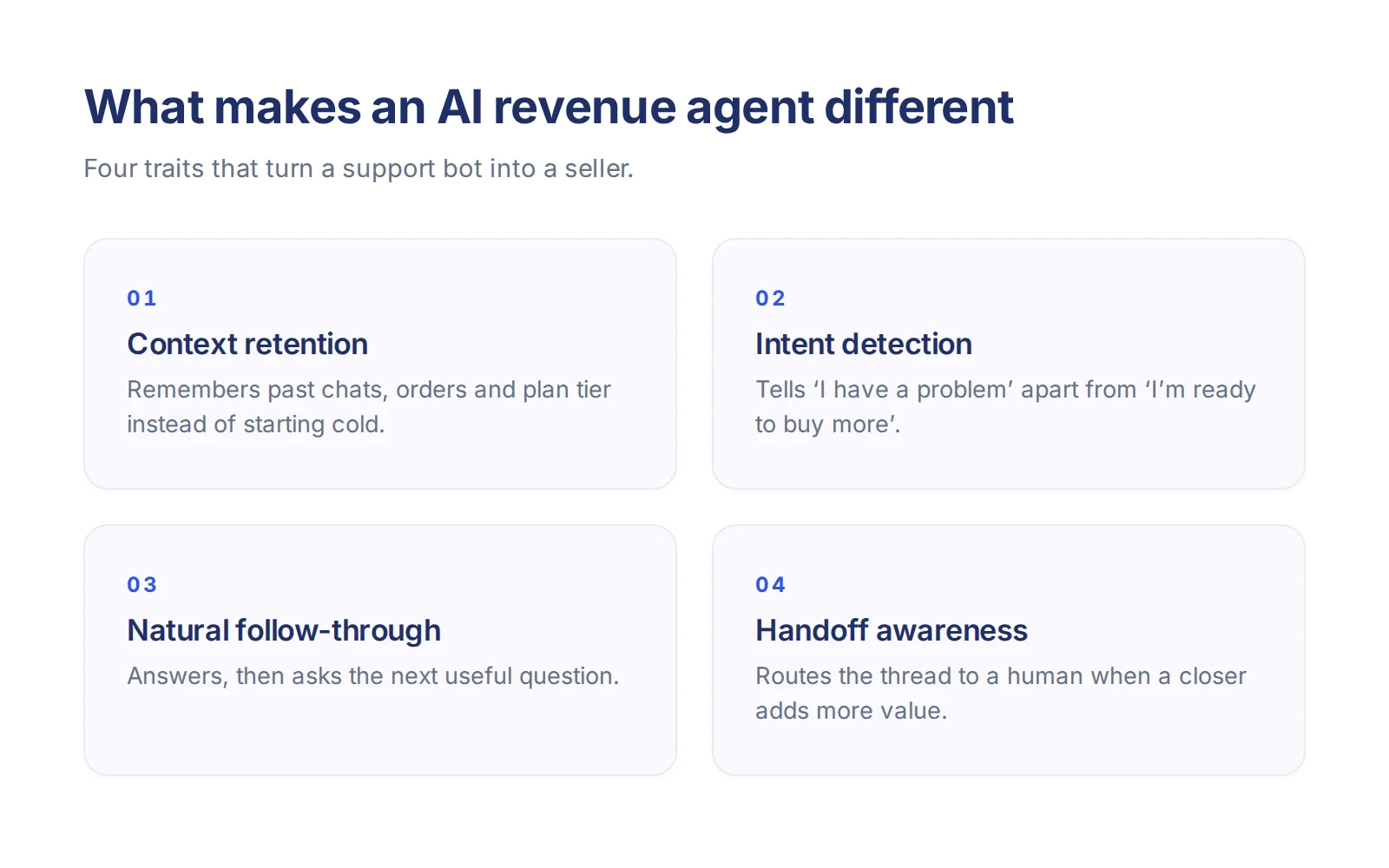
A few things separate a real revenue agent from a basic chatbot:
Context retention — it remembers prior interactions, purchase history, and stated preferences instead of treating every message as a cold start.
Intent detection — it can tell the difference between "I have a problem" and "I'm considering buying more," and responds accordingly.
Natural follow-through — it doesn't just answer and disappear; it asks a relevant next question, suggests a plan upgrade, or offers a relevant product without sounding scripted.
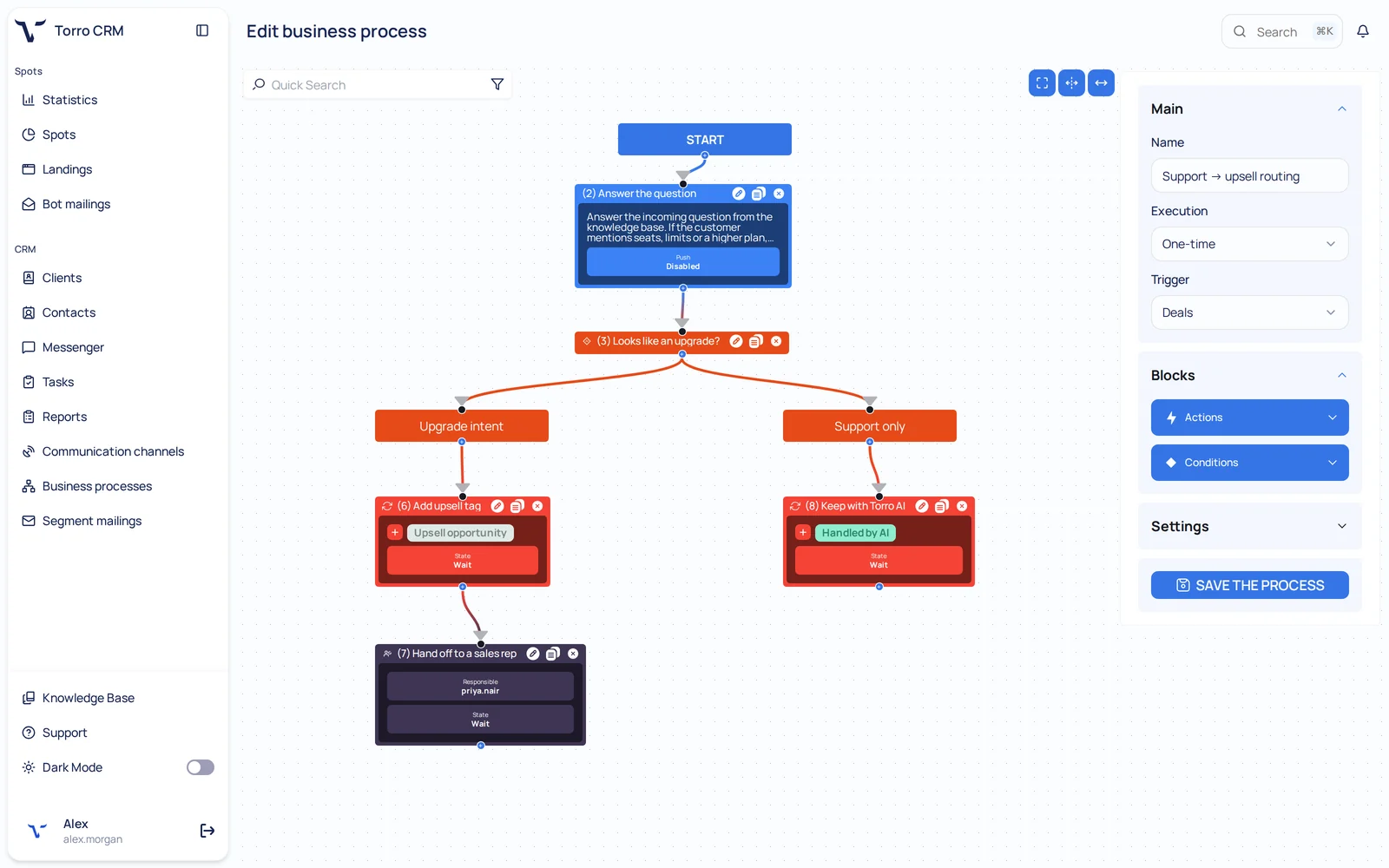
Handoff awareness — when a conversation reaches a point where a human closer adds more value, it flags or routes the thread instead of trying to force a close itself.
This is the shift from a revenue generating chatbot concept to something that actually behaves like a junior sales rep who never sleeps — one who happens to also be great at answering support questions along the way.
Turning Every Support Conversation into a Sales Opportunity
The phrase "turn support bot into sales bot" sounds like a repositioning exercise, but it's really about conversation design. You don't need to bolt a separate sales flow onto your support bot — you need the same agent to carry both jobs fluidly, the way a good human rep would.
Consider the patterns that show up constantly in support inboxes:
A customer asks about a feature that only exists in a higher-tier plan — that's an upsell opening, not just a support answer.
Someone reports they've outgrown their current usage limits — that's a signal to suggest an upgrade, not just a note that they're near the cap.
A user asks if a product works for a second use case — that's cross-sell territory.
Someone churned or paused and comes back with a question — that's a re-engagement moment, not a routine ticket.
An AI agent trained to spot these patterns can respond to the original question and then naturally bridge into the opportunity, e.g., "Yes, that's supported on the Pro plan — want me to switch your account over now?" No hard pivot, no separate sales pitch bolted onto the end — just a continuation of a conversation that was already useful.
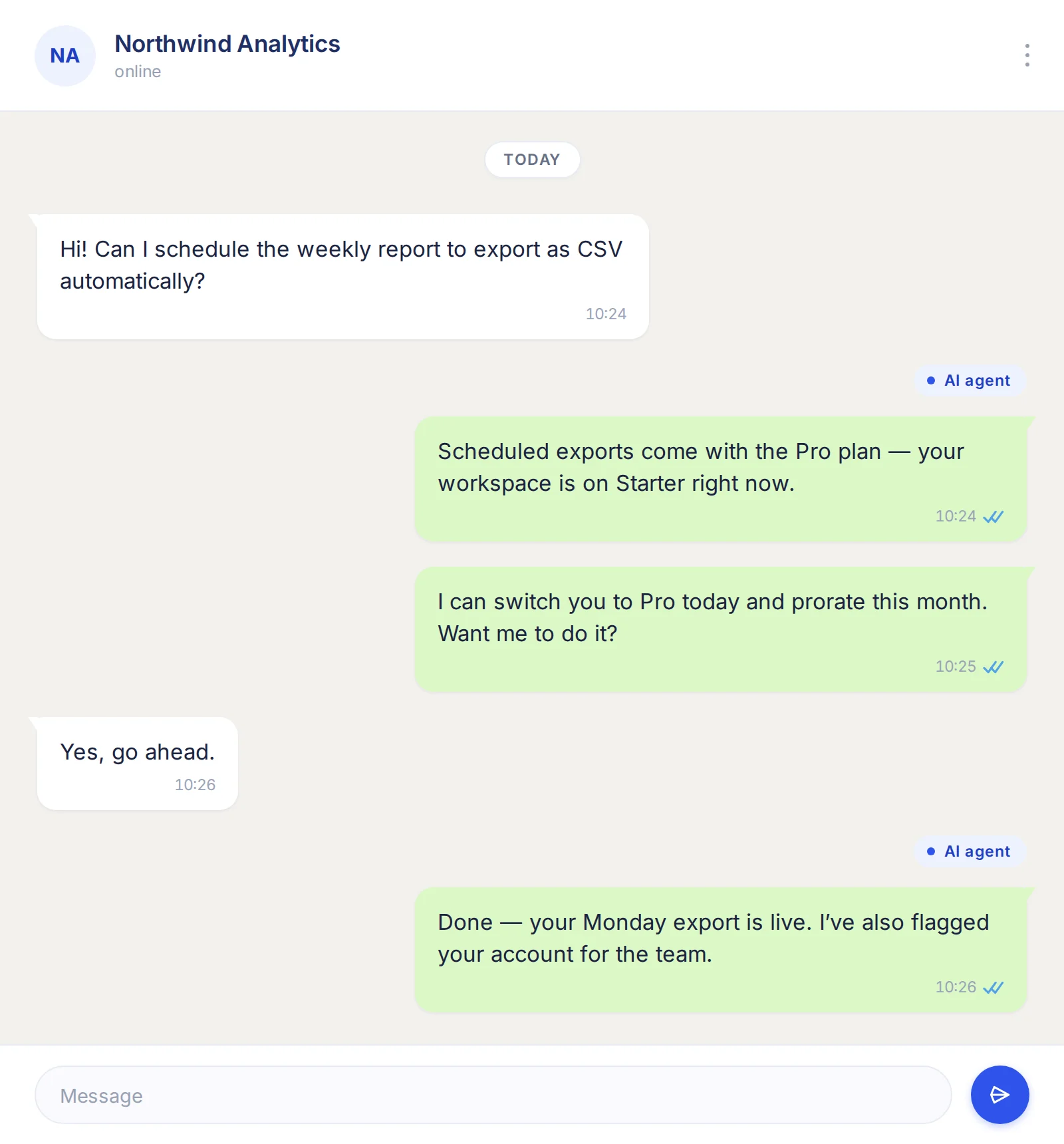
The key is that this only works if support and sales share data. If your support bot lives in one platform and your sales pipeline lives in another, you can't build this kind of continuity — the handoff always breaks somewhere.
How AI Agents Drive Revenue on WhatsApp and Telegram
Messaging apps aren't just a support channel anymore — they're where a growing share of buying decisions actually get made, because customers can ask a question and get an answer without leaving the chat they're already in. That makes an ai agent for whatsapp business and an ai sales chatbot for telegram genuinely different from a website chat widget: the customer is already in a familiar, low-friction environment, often on their phone, often mid-decision.
On WhatsApp, this shows up as agents that can:
Answer product questions in real time and share catalog items or pricing without redirecting to a separate site.
Recover abandoned carts or unfinished conversations with a natural, non-spammy nudge.
Confirm orders, answer post-purchase questions, and then surface a relevant next purchase.
On Telegram, where communities, channels, and bots are more deeply embedded in the culture, an AI agent can:
Handle high volumes of repetitive pre-sale questions inside group chats or channels without needing a human to jump in constantly.
Qualify leads coming from ads or referral links before a rep ever gets involved.
Push personalized offers to segments based on stated interest, not just broad broadcast blasts.
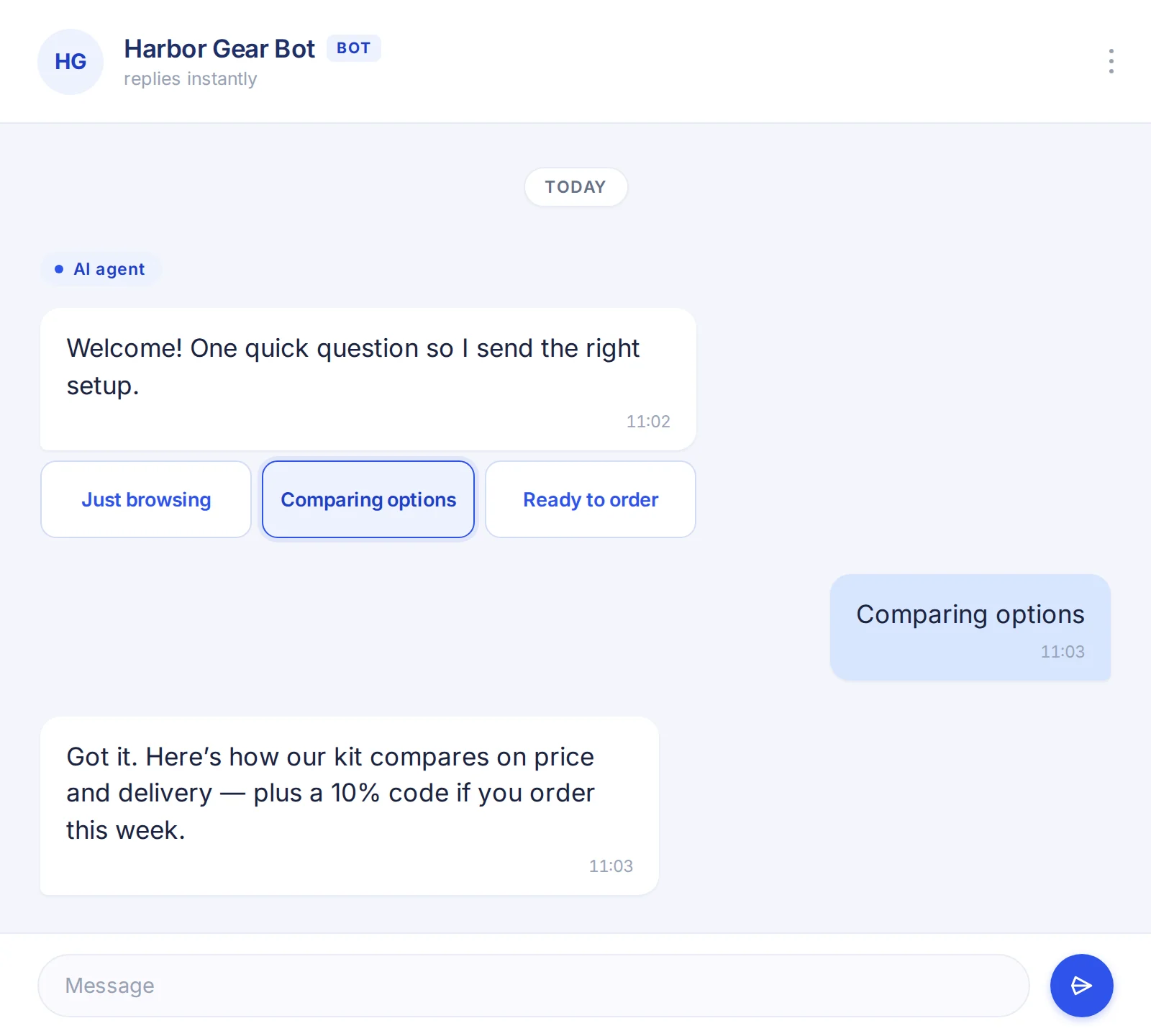
In both cases, the advantage isn't the channel itself — it's that the AI agent operates inside the customer's existing habits instead of asking them to switch context to a web form or a separate app.
Building a Messenger-First CRM Around Revenue Agents
None of this works well if your AI agent is a bolt-on tool disconnected from where your team actually manages relationships. To turn conversations into consistent revenue, you need the agent, the inbox, the pipeline, and the automation logic living in the same system.
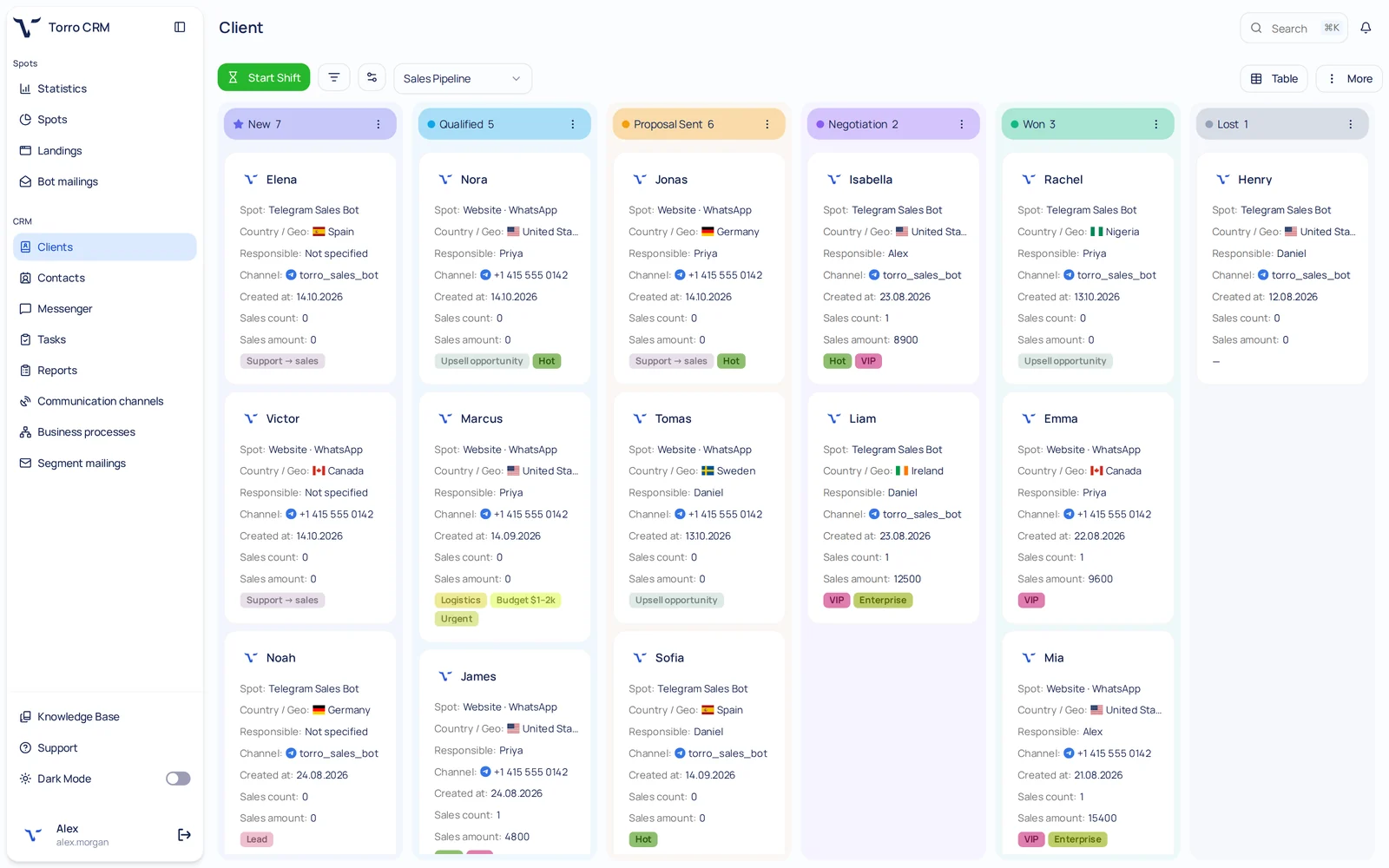
This is where a messenger-first CRM like Torro fits the picture. Rather than treating WhatsApp and Telegram as side channels bolted onto a traditional CRM, Torro is built around the idea that the conversation itself is the primary interface — with an LLM-powered agent sitting inside a shared team inbox, a kanban pipeline for tracking deal stages, and a no-code automation builder for defining when the AI should engage, escalate, or hand off to a human.
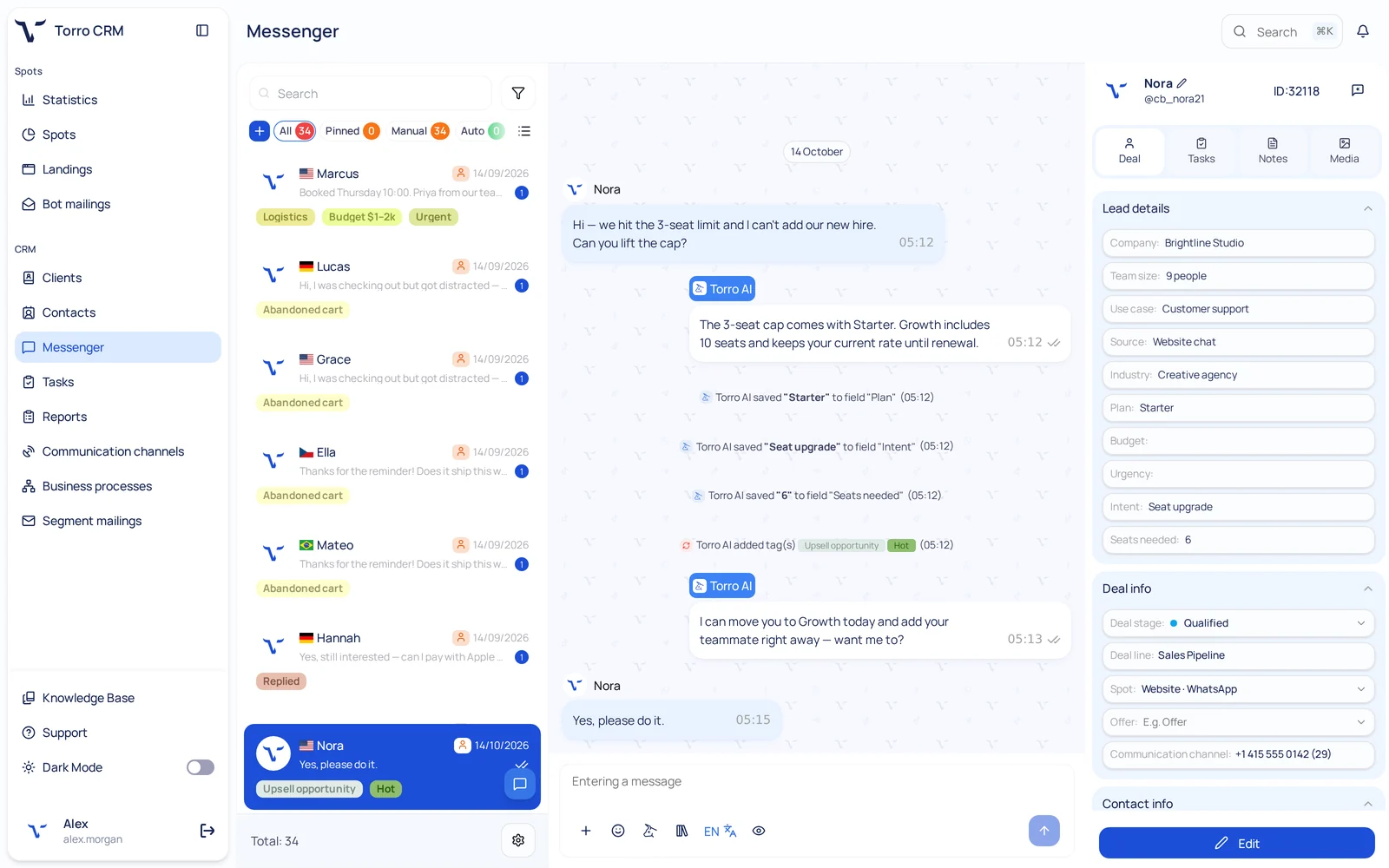
In practice, that structure matters because:
The AI agent has visibility into the same pipeline stage and deal history a human rep would see, so it doesn't repeat questions or miss context.
When a conversation needs a human touch — negotiating price, handling a complaint, closing a bigger deal — the shared inbox lets a rep pick up exactly where the AI left off.
Automation rules can route "hot" conversations (based on intent signals) straight into a pipeline stage, while routine questions stay with the AI.
WhatsApp connectivity via API or linked device means businesses of different sizes — from a single-number small operation to a multi-agent team — can plug into the same workflow.
Broadcasts and analytics close the loop, letting teams see which conversations actually convert and refine the agent's scripts and triggers accordingly.
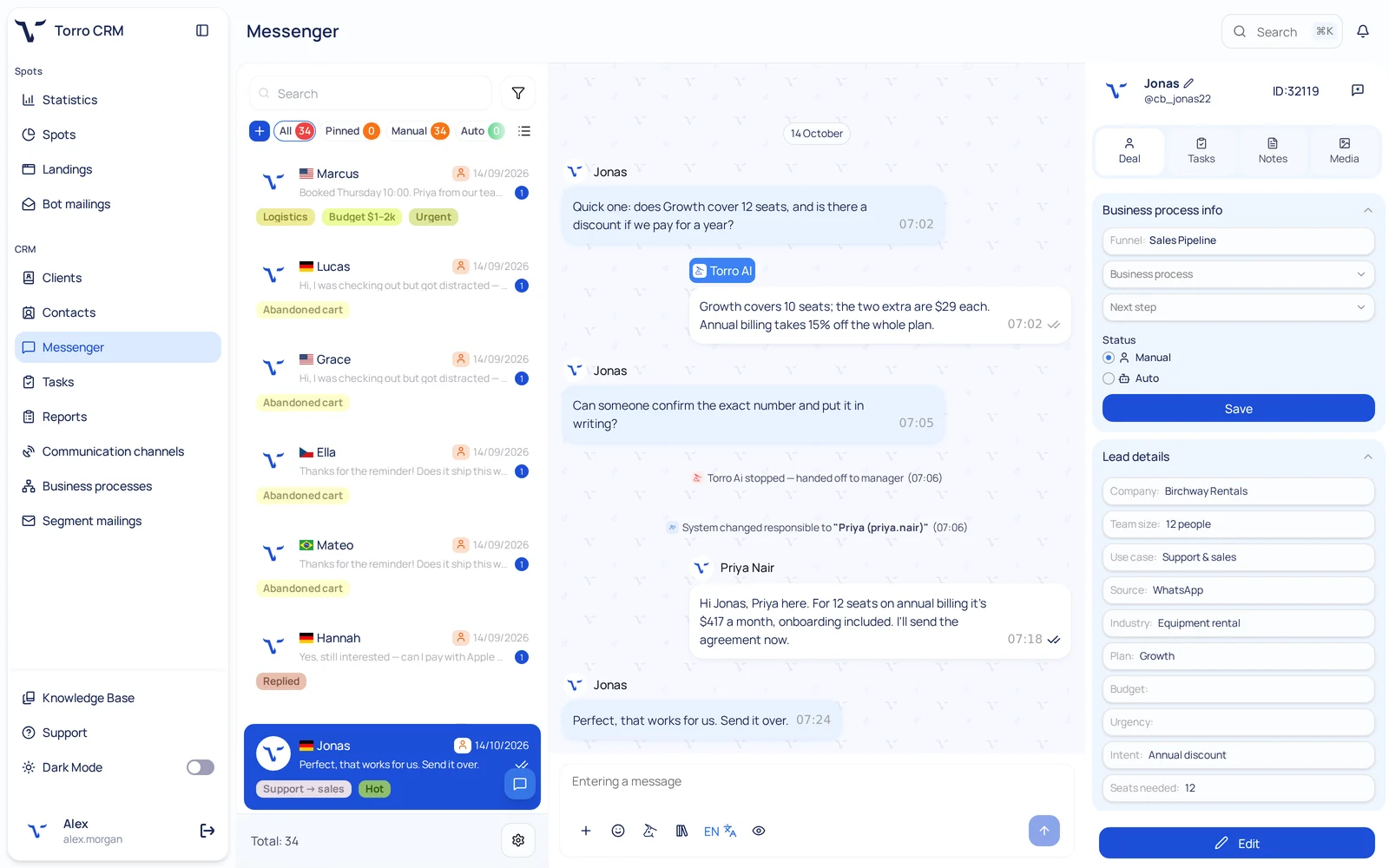
The point isn't the tool for its own sake — it's that revenue agents need infrastructure around them. An AI that's great at spotting opportunity but has nowhere to route it, and no pipeline to track it, just generates missed follow-ups instead of closed deals.
Real Results: From Ticket Resolution to Deal Closure
The shift from "ticket closed" to "deal closed" as a success metric changes how teams evaluate their bots entirely. Instead of measuring first-response time or deflection rate in isolation, teams applying this approach start tracking:
Conversation-to-opportunity rate — how many support threads surface a genuine sales signal.
AI-assisted upsell rate — how often an agent's suggestion leads to an upgrade or additional purchase.
Time-to-handoff — how quickly a hot lead gets routed to a human closer instead of stalling in the AI's queue.
Revenue per conversation — a blended metric that treats every chat as a potential contributor to the top line, not just a cost center to minimize.
The comparison below outlines the practical difference between the two models side by side:
Aspect | Traditional Support Bot | AI Revenue Agent |
|---|---|---|
Primary goal | Resolve or deflect the ticket | Resolve the issue and surface relevant opportunities |
Conversation memory | Limited to current session | Persistent across sessions and channels |
Response style | Scripted, keyword-matched | Context-aware, natural follow-through |
Handoff to sales | Rare or manual | Automated, based on intent signals |
Success metric | Resolution time, deflection rate | Revenue per conversation, upsell rate |
Where it lives | Standalone widget or bot platform | Integrated CRM with pipeline and inbox |
Teams that make this shift often find that the biggest gains don't come from some dramatic new sales pitch built into the bot — they come from simply not letting obvious buying signals fall through the cracks that used to exist between support and sales.
Getting Started: Deploying Your First Revenue-Generating AI Agent
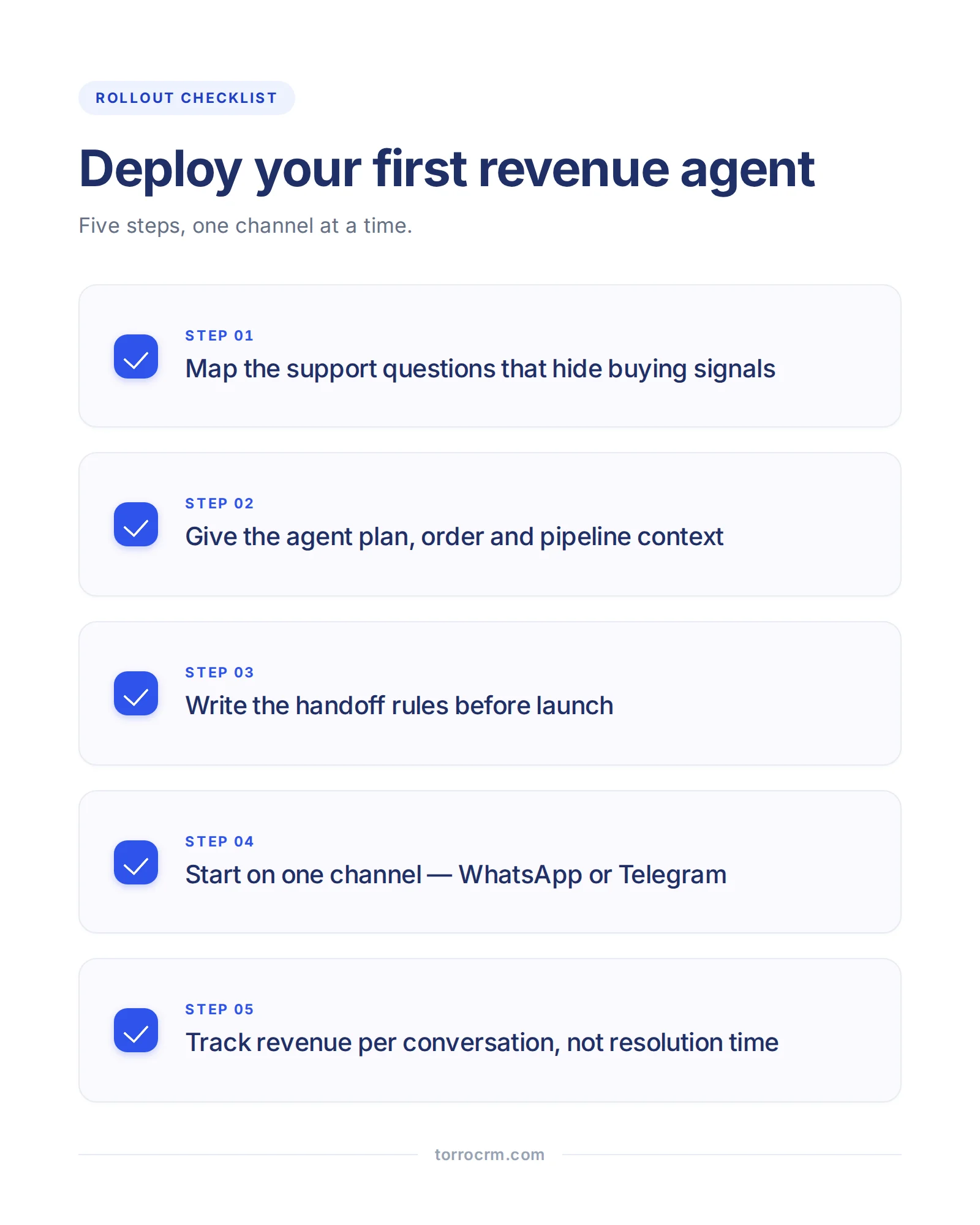
You don't need to rebuild your entire support stack to start capturing this kind of value. A practical rollout usually looks like this:
Map your recurring support questions and flag which ones commonly correlate with upsell, cross-sell, or renewal opportunities.
Give the AI agent access to customer and deal context — plan tier, purchase history, current pipeline stage — so its suggestions are relevant, not generic.
Define clear handoff rules — at what point does the AI flag a human, and what information does it pass along so the rep doesn't have to ask the customer to repeat themselves?
Start on one channel, whether that's WhatsApp or Telegram, rather than trying to launch everywhere at once. Learn what triggers actually convert before scaling out.
Track conversation outcomes, not just resolution speed, and iterate on the agent's prompts and automation rules based on what's actually driving deals forward.
The businesses that get the most out of this approach treat their AI agent less like a cost-saving tool and more like a team member with a specific job: keep the customer happy and notice when there's more they might need. That single mindset shift — from ticket-closer to conversation partner — is what separates a support bot from a genuine revenue driver.