Running paid traffic to Telegram bot funnel setups feels deceptively simple: you write an ad, point it at a t.me link, and watch subscribers roll in. Then the invoice arrives. Facebook says your cost per result is $0.40, your bot analytics say you paid $3.10 per actual start, and nobody can explain where the other 87% of clicks went. Meanwhile the algorithm is happily optimizing toward a signal that has nothing to do with your revenue, because you never told it what revenue looks like.
This guide walks through the plumbing that makes messenger funnels measurable: deep link tracking, server-side conversion feedback into Facebook Conversion API, Google Ads and TikTok Events API, choosing the right optimization event, and finally converting those subscribers into paying customers instead of a dead audience list.
Why Telegram Traffic Breaks Ad Optimization (And What It Costs You)
Every mainstream ad platform was built for websites. Their measurement model assumes a browser, a pixel, a cookie or a device ID, and a page you control. Telegram breaks all four assumptions at once.
When someone taps your ad, the flow looks like this: ad click → browser or in-app webview opens t.me/yourbot → operating system prompt "Open in Telegram?" → app switch → bot chat screen → user must tap Start. Each arrow is a drop-off point, and none of them are visible to the pixel.
- App-switch loss. A meaningful share of users never complete the handoff — old Telegram versions, no app installed, in-app browsers that block the deep link, or simple hesitation at the OS prompt.
- The silent Start. Telegram opens the chat but does not auto-subscribe. Users who land and never tap Start are paid clicks with zero data.
- No pixel inside the chat. Nothing that happens after Start — messages, answers, qualification, checkout — is visible to Facebook or Google unless you send it yourself.
- Broken attribution. Without a start parameter, you cannot tell which campaign, ad set or creative produced a given subscriber. Optimization becomes guesswork.
The practical cost is not just wasted spend. It is misdirected spend. If the platform only sees link clicks, it learns to find people who tap links: cheap, curious, low-intent. Your cost per Telegram subscriber looks fine on the dashboard and terrible in the bank account. Fixing measurement is not a reporting exercise — it changes who the algorithm delivers to.
Map the Funnel First: From Ad Click to Bot Start to Paying Customer
Before touching APIs, write down every stage and decide what you will name it. Naming matters because these labels become your event names across three ad platforms and your CRM.
- Ad click — platform-side, already tracked.
- Bot start — user tapped Start; you now have a Telegram user ID and, if you did it right, campaign attribution.
- First reply — user answered your opening message. This is your first real engagement signal and it filters out accidental starts and bots.
- Qualified lead — user gave you something that predicts value: budget range, city, product interest, phone number, calendar booking.
- Purchase / paid — money moved, with a value you can pass back.
Now measure the conversion rate between each pair for a week before you optimize anything. Typical patterns worth watching: if click → start is weak, the problem is creative promise or the landing step, not targeting. If start → first reply is weak, your opening message is bad. If qualified → purchase is weak, you have a sales problem, not a traffic problem. Feeding bad conversions into an ad algorithm just scales the wrong bottleneck faster.
Track Every Bot Event: Deep Links, Start Parameters and Server-Side Signals
The mechanism that makes all of this work is the Telegram start parameter. A link in the form https://t.me/yourbot?start=fb_c123_a456_cr7 passes that payload to your bot in the very first update. Your bot reads it, stores it against the Telegram user ID, and from that moment every action by that user is attributable.
Practical rules for start parameters:
- Keep it short. The parameter has a length limit and only allows a restricted character set (letters, digits, underscore, hyphen). Use compact codes, not full UTM strings.
- Use a lookup table. Store
c123 → campaign nameserver-side rather than encoding human-readable names in the link. - Encode what you will act on: platform, campaign, ad set, creative. Placement and audience are useful if you split-test them separately.
- Use dynamic parameters where available so you are not hand-building hundreds of links.
If you need higher-fidelity click matching — especially for Facebook — route traffic through a lightweight bridge page you own. The bridge fires the pixel, captures fbclid / gclid / ttclid, browser identifiers and user agent, mints a short click ID, then redirects to the bot with that click ID as the start parameter. You lose a fraction of users to the extra hop, but you gain the identifiers required for reliable server-side attribution. Test both approaches; the answer depends on your traffic mix.
Whatever you build, persist these fields per subscriber: click ID, platform, campaign codes, timestamp of start, and then every downstream milestone. In a messenger-first CRM like Torro, that attribution lands on the contact card and travels with the deal through the kanban pipeline, so your pipeline report answers "which creative produced closed revenue" instead of "which creative produced clicks."
Feed Real Conversions Back to Facebook Conversion API, Google Ads and TikTok Events API
Server-side conversion feedback is the single highest-leverage change in a messenger funnel. Instead of optimizing on clicks, you send the platform your actual funnel events from your server.
For Facebook conversion API and Telegram bot funnels, you send events with an event name, event time, an action_source of system_generated or business_messaging depending on your setup, and the strongest matching keys you have — fbc built from the captured fbclid, fbp, hashed email or phone if the user gave one, plus IP and user agent from the bridge page. Deduplicate against pixel events using a shared event_id. Send events promptly; late events are less useful for optimization even when they still attribute.
For Google Ads Telegram traffic, the tool is offline conversion import or enhanced conversions for leads. You upload the captured gclid (or wbraid/gbraid for app-to-web journeys) together with a conversion action name, a timestamp and a value. Google needs the click identifier, so the bridge page is effectively mandatory here unless you collect an email or phone you can hash and match.
For TikTok ads Telegram funnel tracking, the Events API accepts server events with ttclid, hashed contact data and event values. TikTok's audiences skew younger and more impulsive, so the gap between "started the bot" and "qualified" tends to be wider — which makes deep-funnel feedback more valuable, not less.
| Platform | Server-side tool | Primary match key | Bridge page needed? | Best optimization event |
|---|---|---|---|---|
| Facebook / Instagram | Conversion API | fbc from fbclid, fbp, hashed phone/email | Strongly recommended | Qualified lead or purchase |
| Google Ads | Offline conversion import / enhanced conversions for leads | gclid, wbraid, hashed email or phone | Yes, in practice | Qualified lead, then purchase value |
| TikTok Ads | Events API | ttclid, hashed phone/email | Recommended | First reply early, qualified lead later |
Choose the Right Optimization Event: Subscriber, Qualified Lead or Purchase
Deeper events produce better traffic — but only if you generate enough of them for the algorithm to learn. The trade-off is volume versus quality.
- Under roughly 50 conversions per ad set per week at the deep event: optimize for bot start or first reply. You will get volume and the model will actually exit learning.
- 50+ qualified leads per week: move to the qualified lead event. This is where most B2C and mid-ticket funnels should live.
- Consistent purchase volume with reliable values: optimize for purchase with value, and let value-based bidding do the sorting.
A practical pattern is the two-stage ladder: launch on bot start to gather data fast, then once you have four to six weeks of clean event history, duplicate the winning ad sets and switch them to the qualified-lead event. Keep the shallow-event campaigns running at a smaller budget as a discovery layer.
One caution: send only events you can define consistently. If "qualified lead" means three different things across your team, the algorithm learns noise. Codify qualification as a pipeline stage or a set of answered questions, not a human judgement call.
Cut Your Cost Per Telegram Subscriber Without Buying Junk Traffic
Cheap subscribers are easy to buy and usually worthless. The goal is a lower cost per qualified subscriber. Levers worth testing, roughly in order of impact:
- Reduce the app-switch friction. Make the ad copy state explicitly that the next step opens Telegram. Users who know what is coming complete the handoff more often than users who feel ambushed.
- Deliver value in the first message. The Start tap is a leap of faith; pay it off immediately with the promised checklist, price list, discount code or diagnostic question. Do not open with a menu of eleven buttons.
- Ask one qualifying question early. A single question ("What are you shopping for?") lifts first-reply rate and gives you a segmentation field for later broadcasts.
- Match creative promise to bot content. Mismatch shows up as high start rate and near-zero reply rate — a signal the platform will happily scale if you optimize on starts alone.
- Exclude existing subscribers. Upload your subscriber list as an audience exclusion where the platform allows it. Paying to re-acquire people already in your bot is a quiet, persistent leak.
- Test the bridge page seriously. Sometimes a direct t.me link wins on start rate; sometimes a bridge page wins on qualified-lead cost because the tracking is better. Measure both on the deep event, not the shallow one.
- For Facebook ads to Telegram channel campaigns, route through a bot rather than the channel directly whenever you can. Channels give you almost no measurable events; a bot gives you attribution, conversation and a path to revenue.
Turn New Subscribers Into Revenue With an AI Sales Agent in Your CRM
Measurement gets you better traffic. Revenue comes from what happens in the next twenty minutes after Start — and that is where most paid messenger funnels quietly fail. Leads arrive at 2am, on weekends, in three languages, faster than a two-person team can reply. Response delay is the most expensive variable in the entire funnel, and it is entirely within your control.
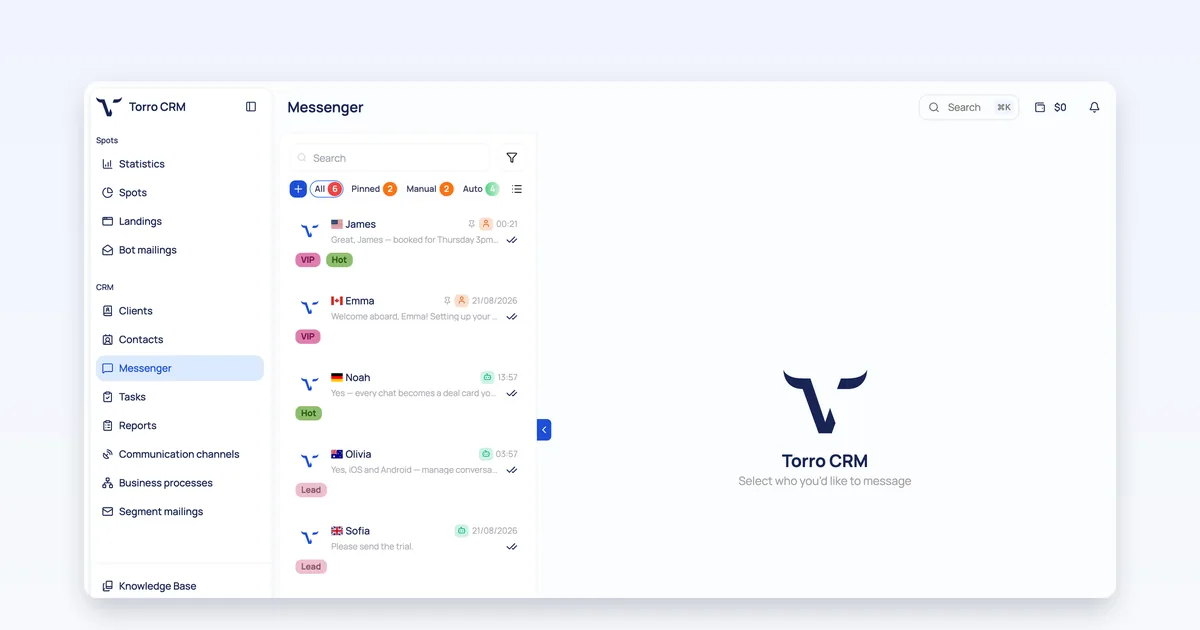
This is the case for putting an LLM-based AI sales agent at the front of the pipeline. It greets every new subscriber instantly, asks your qualification questions in natural conversation, answers product and pricing questions from your knowledge base, handles objections, and books calls — then hands off to a human the moment the conversation needs one. In Torro, that agent sits inside the same shared inbox your team uses, so there is no handoff gap: an operator sees the full history, takes over mid-thread, and the deal card moves along the kanban pipeline automatically.
The loop closes when pipeline stages become conversion events. When the AI agent marks a subscriber as qualified, the automation builder can fire the server-side event to Facebook, Google and TikTok. When a deal reaches "won," the purchase value goes back with it. Subscribers who stall get a broadcast or an automated follow-up sequence instead of decaying into a dead list, and analytics show cost per qualified lead by creative rather than cost per click.
Build the measurement layer, choose the optimization event your volume can support, and make sure every paid subscriber gets an instant, useful reply. Do those three things and paid Telegram traffic stops being a subscriber-counting exercise and starts behaving like a real acquisition channel.